
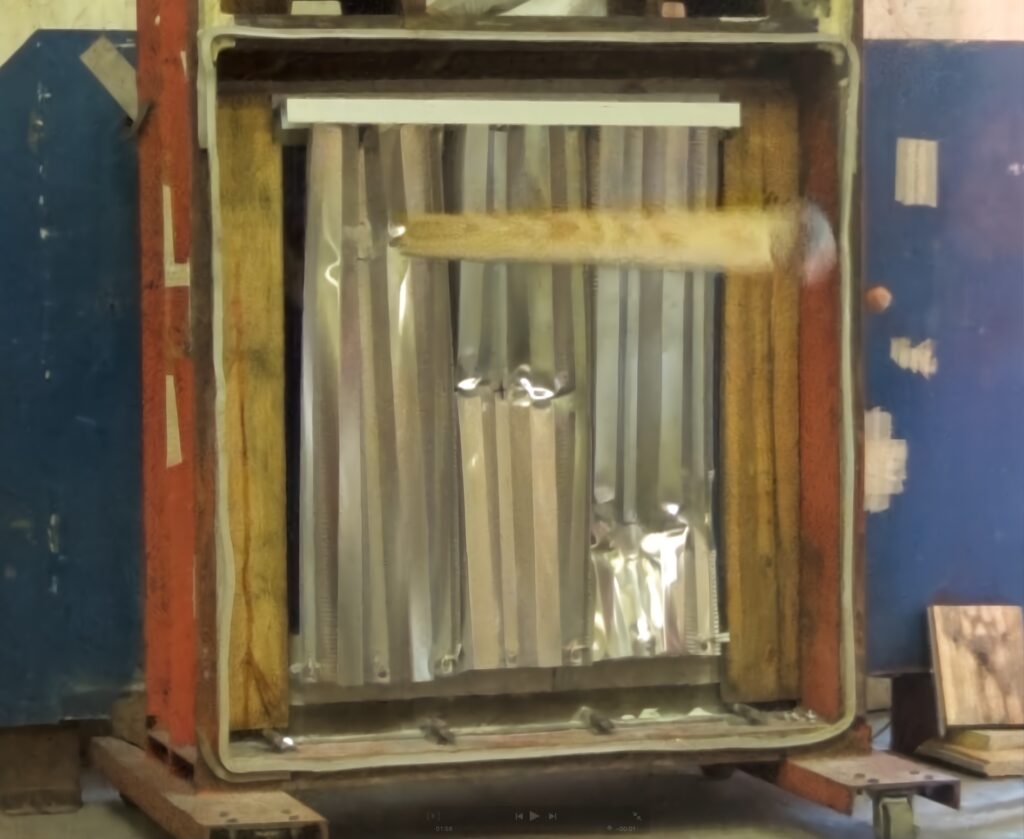
Overview of Missile Impact Levels
As adopted in the 2023 Florida Building Code and the 2021 International Building Code, ASTM E1996-17 defines how exterior glazing systems (windows, doors, curtain walls) for habitable structures should resist windborne debris during hurricanes.
The Five Missile Impact Levels
-
Level A — Small Missile Impact
A 2 g steel ball fired at 130 ft/s at specified target points. -
Level B — Lightweight Projectile
A 2 lb “2×4” fired at 50 ft/s. Not used in wall applications. -
Level C — Medium Missile Impact
A 4 lb “2×4” at 40 ft/s. Used selectively in Wind Zones 1 & 2. -
Level D — Large Missile Impact (Common Standard)
A 9 lb “2×4” shot at 50 ft/s. This is the baseline requirement for many hurricane-prone zones. -
Level E — Enhanced Protection (Essential Facilities)
Same 9 lb “2×4,” but fired at 80 ft/s. Reserved for critical infrastructure (hospitals, emergency centers, shelters).
Learn More About Protection Categories
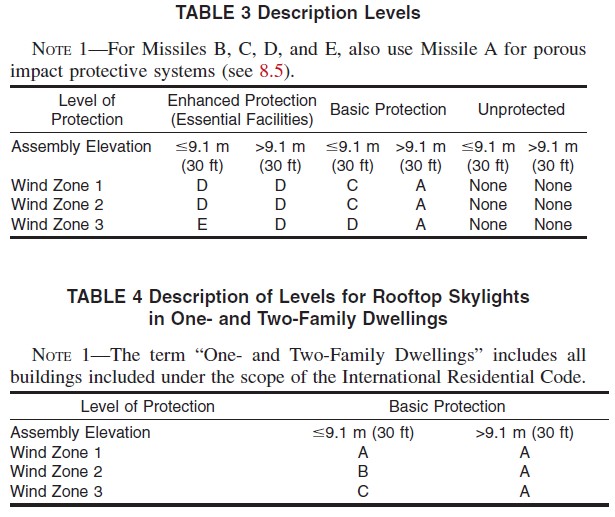
ASTM E-1996 doesn’t just define the missile levels — it also sets out who needs what level of protection.
Section 6.2.1 divides buildings into three categories:
Enhanced Protection (6.2.1.1)
- Applies to essential facilities, which must withstand Missile Level E impacts.
These include:
Hospitals and health care facilities with emergency services
Jails and detention centers
Fire, rescue, and police stations
Emergency vehicle garages
Designated emergency shelters
Communication centers and facilities critical to emergency response
Power plants and public utility facilities required during an emergency
Buildings serving critical national defense functions
These include:
Hospitals and health care facilities with emergency services
Jails and detention centers
Fire, rescue, and police stations
Emergency vehicle garages
Designated emergency shelters
Communication centers and facilities critical to emergency response
Power plants and public utility facilities required during an emergency
Buildings serving critical national defense functions
Basic Protection (6.2.1.2)
Covers the majority of buildings and structures not classified as essential or low-hazard. These must meet the baseline missile impact requirements for their wind zone.
Unprotected (6.2.1.3)
Reserved for structures that present minimal risk to life in a windstorm. Examples:
Agricultural buildings
Production greenhouses
Certain temporary structures
Storage facilities
Learn More About Protection Categories
ASTM E-1996 doesn’t just define the missile levels — it also sets out who needs what level of protection.
Section 6.2.1 divides buildings into three categories:
Enhanced Protection (6.2.1.1)
Applies to essential facilities, which must withstand Missile Level E impacts.
These include:
Hospitals and health care facilities with emergency services
Jails and detention centers
Fire, rescue, and police stations
Emergency vehicle garages
Designated emergency shelters
Communication centers and facilities critical to emergency response
Power plants and public utility facilities required during an emergency
Buildings serving critical national defense functions
Basic Protection (6.2.1.2)
Covers the majority of buildings and structures not classified as essential or low-hazard. These must meet the baseline missile impact requirements for their wind zone.
Unprotected (6.2.1.3)
Unprotected (6.2.1.3)
Reserved for structures that present minimal risk to life in a windstorm. Examples:
Agricultural buildings
Production greenhouses
Certain temporary structures
Storage facilities
Wind Zones
- Zone 1: Basic wind speed 130–139 mph.
- Zone 2: 140–149 mph, typically further inland.
- Zone 3: 150 mph or greater, or any location within 1 mile of the coast.
- Zone 4: This category was removed from the main body of ASTM E1996 in 2014 (and reaffirmed in 2017 and 2020). It now appears only in Appendix X4 as an optional reference.
Important Notes on ASTM E1996
- The current standard referenced in codes is ASTM E1996-17, adopted in both the 2023 Florida Building Code and the 2021 International Building Code.
- When substituting glass or framing elements from what was originally tested, dimensions and stress levels cannot exceed the tested configuration. Doing so would invalidate compliance with the standard.
- Large missile impact requirements are not applied universally. They are primarily enforced in hurricane-prone regions, with essential facilities (hospitals, nursing homes, emergency response centers, shelters) subject to the most stringent criteria.
- Design professionals must carefully match the required missile level with the project’s location, occupancy type, and code-defined wind zone to ensure both safety and compliance.
- The current standard referenced in codes is ASTM E1996-17, adopted in both the 2023 Florida Building Code and the 2021 International Building Code.
- When substituting glass or framing elements from what was originally tested, dimensions and stress levels cannot exceed the tested configuration. Doing so would invalidate compliance with the standard.
- Large missile impact requirements are not applied universally. They are primarily enforced in hurricane-prone regions, with essential facilities (hospitals, nursing homes, emergency response centers, shelters) subject to the most stringent criteria.
- Design professionals must carefully match the required missile level with the project’s location, occupancy type, and code-defined wind zone to ensure both safety and compliance.
For guidance with your next project, explore our Plans, Calculators, Knowledge Base,
or contact us directly for site-specific support
Last Update: November 17, 2025
Related Knowledge Base Posts -
- Should a professional utilize the ASD (Allowable Stress Design) method or the LRFD (Load Resistance Factored Design) method when calculating the required wind pressure for use with tested-approved systems?
- Did the wind loading requirements change for rooftop structures for ASCE 7-22 – ASCE 7-16 & The Florida Building Code?
- What wind speed should I use for my project?
- ASCE 7 WIND EXPOSURE CATEGORIES AND HOW EXPOSURE ‘D’ WORKS
- What is a window or door buck
- The One-Third (1/3) Stress Increase: Where Is It Now?