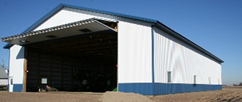
Understanding whether a building is partially enclosed is a critical step in wind design. This classification determines the internal pressure coefficients (GCpi) used in ASCE 7 and directly affects the loads applied to components such as windows, doors, roofs, and wall systems.
Definition (ASCE 7-16 / FBC Reference)
A structure is considered partially enclosed when:
The total area of openings in one wall (A₀) exceeds the sum of openings in the remaining walls and roof (Aₒᵢ ) by more than 10%:
Aₒ>1.10×Aₒᵢ
The total area of openings in that dominant wall (A₀) is greater than 4 ft² (0.37 m²) and less than 20% of the gross area of that wall
Aₒᵢ /A₉ᵢ ≤ 0.20
Worked Example
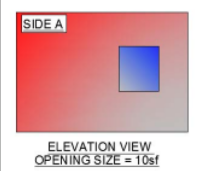
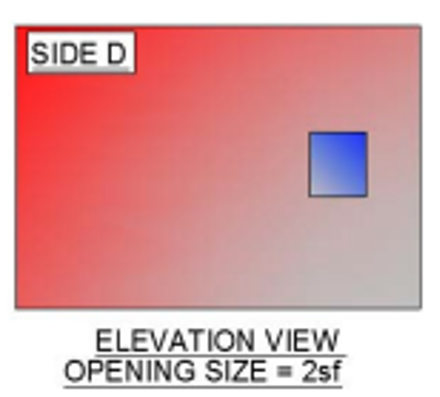
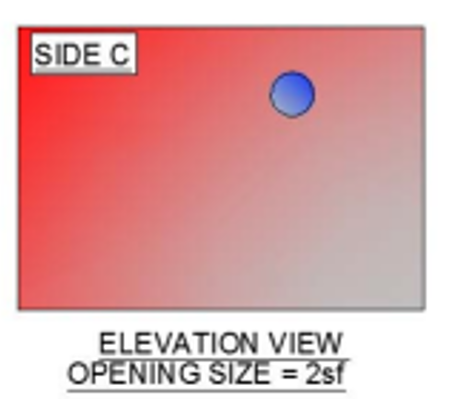
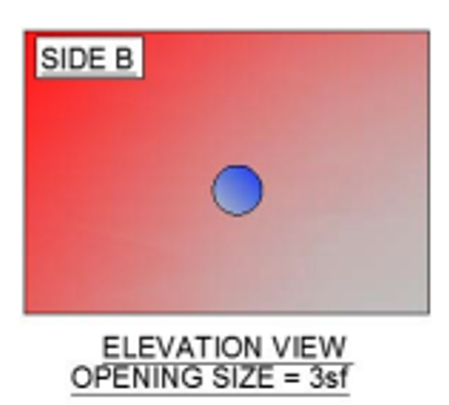
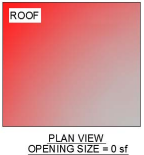
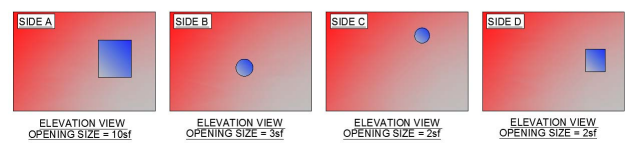
Consider a structure with five sides (four walls and a roof), having a gross area of 20 ft². The openings are shown in blue below:
concrete example of a partially enclosed structure 4
concrete example of a partially enclosed structure
concrete example of a partially enclosed structure 2
concrete example of a partially enclosed structure 3
concrete example of a partially enclosed structure roof
Conclusion: Both conditions are met → The structure is Partially Enclosed.
Condition 1
Aₒ = 10 ft² (Side A)
Aₒᵢ = 3+2+2+0 = 7 ft²
1.10×Aₒᵢ = 7.7ft²
Condition 2
Aₒ = 10 ft² > 4 ft²
A₉ᵢ = 4×20 ft²+20 ft² = 80 ft²
Aₒᵢ /A₉ᵢ = 7/80 = 0.0875 ≤ 0.20
ASCE 7-16 Guidance on Enclosure Definitions
According to ASCE 7-16 Section C26.2, the definitions of enclosed, open, and partially enclosed buildings are specifically intended to guide the selection of the correct internal pressure coefficient (GCpi).
All other structures that do not clearly meet one of these three definitions are classified as partially open by default. These include buildings with large openings on multiple walls—such as parking garages, where wind can pass freely through but the structure does not satisfy the strict “open” or “partially enclosed” criteria.
For such partially open structures, the internal pressure coefficient (GCpi) is typically ±0.18, and these pressures are applied to the solid portions of the walls and roof.
Importantly, if a building meets both the “open” and “partially enclosed” definitions, ASCE 7 requires it to be classified as “open.” This ensures that the more accurate (and typically less conservative) internal pressure assumptions are applied in design.
File renewals at least 3 months before expiration to allow Miami-Dade’s 60-day review and comment process.
If working with Engineering Express or another consultant, contact them 6 months in advance for quoting and preparation.
Engineering Express uses cookies to improve your experience, deliver personalized content, & analyze our traffic. By using our website, you consent to the use of cookies.
This website uses cookies to improve your experience while you navigate through the website. Out of these, the cookies that are categorized as necessary are stored on your browser as they are essential for the working of basic functionalities of the website. We also use third-party cookies that help us analyze and understand how you use this website. These cookies will be stored in your browser only with your consent. You also have the option to opt-out of these cookies. But opting out of some of these cookies may affect your browsing experience.
Necessary cookies are absolutely essential for the website to function properly. These cookies ensure basic functionalities and security features of the website, anonymously.
Cookie
Duration
Description
cookielawinfo-checkbox-analytics
11 months
This cookie is set by GDPR Cookie Consent plugin. The cookie is used to store the user consent for the cookies in the category "Analytics".
cookielawinfo-checkbox-functional
11 months
The cookie is set by GDPR cookie consent to record the user consent for the cookies in the category "Functional".
cookielawinfo-checkbox-necessary
11 months
This cookie is set by GDPR Cookie Consent plugin. The cookies is used to store the user consent for the cookies in the category "Necessary".
cookielawinfo-checkbox-others
11 months
This cookie is set by GDPR Cookie Consent plugin. The cookie is used to store the user consent for the cookies in the category "Other.
cookielawinfo-checkbox-performance
11 months
This cookie is set by GDPR Cookie Consent plugin. The cookie is used to store the user consent for the cookies in the category "Performance".
viewed_cookie_policy
11 months
The cookie is set by the GDPR Cookie Consent plugin and is used to store whether or not user has consented to the use of cookies. It does not store any personal data.
Functional cookies help to perform certain functionalities like sharing the content of the website on social media platforms, collect feedbacks, and other third-party features.
Performance cookies are used to understand and analyze the key performance indexes of the website which helps in delivering a better user experience for the visitors.
Analytical cookies are used to understand how visitors interact with the website. These cookies help provide information on metrics the number of visitors, bounce rate, traffic source, etc.
Advertisement cookies are used to provide visitors with relevant ads and marketing campaigns. These cookies track visitors across websites and collect information to provide customized ads.