
Open Structures Explained
Determining if a structure qualifies as an open building is a fundamental step in wind design. The classification directly affects how internal pressures (GCpi) are applied per ASCE 7-16 Section C26.2, ensuring that the correct wind load assumptions are used for safety and performance.
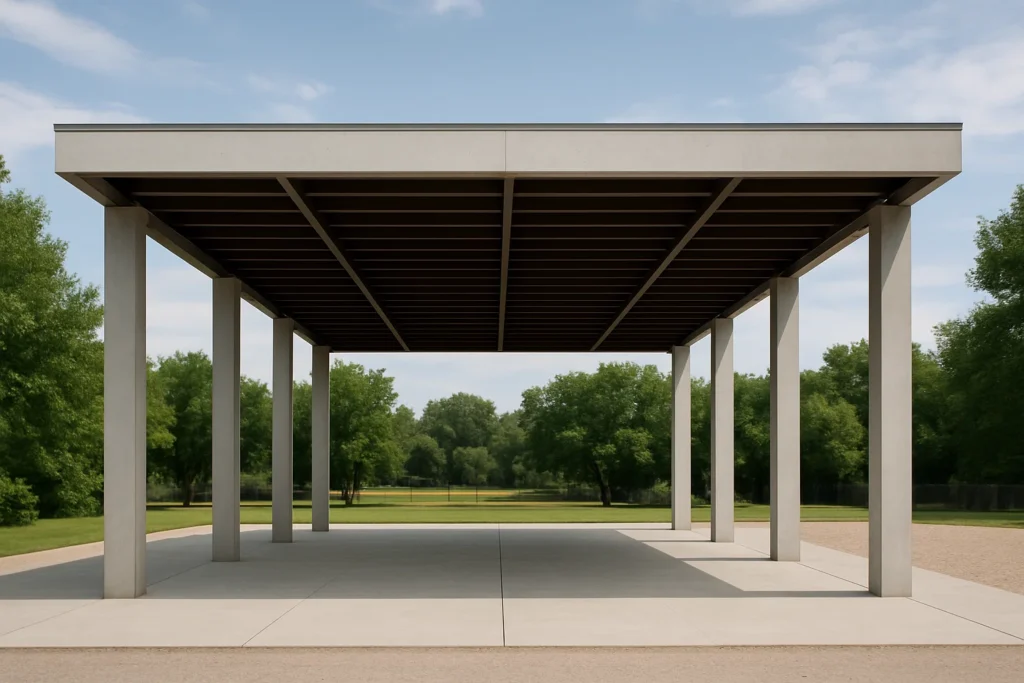
Definition
(ASCE 7-16 / FBC Reference)
A building is considered open when each wall is at least 80 percent open, allowing air to flow freely through the structure.
- This condition is expressed by the equation:
Aₒ ≥ 0.8 A₉
Where :
- Aₒ = Total area of openings in a wall receiving positive external pressure
- A₉= = Gross area of that wall
Worked Example
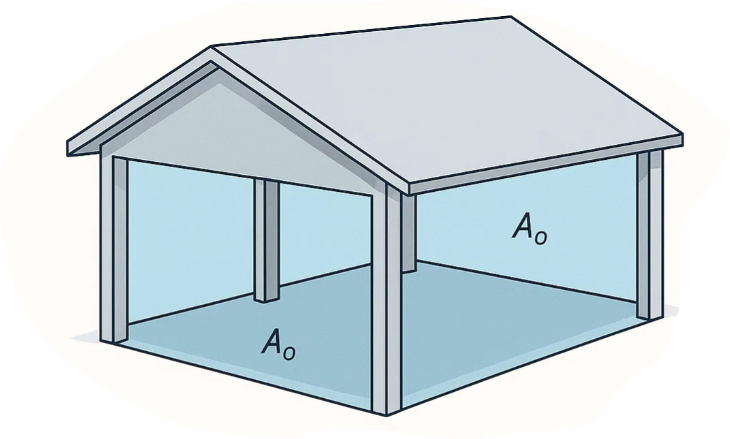
The structure shown below includes three large openings (represented in blue).
If the blue area (Aₒ) equals or exceeds 80 percent of the total wall area (A_g) for each wall, the building qualifies as open.
This condition must be satisfied for all exterior walls—not just one or two—to ensure the building behaves aerodynamically as an open structure.
Engineering Interpretation & Design Implications
In an open building, air flows freely through the structure, creating negligible internal pressure. Engineers therefore focus on external wind pressures—positive on the windward side and suction on the leeward.
Because there are no enclosing walls to share loads, framing and connections must resist all external forces. Designers should provide adequate bracing, ensure strong roof uplift resistance, and size members for both positive and negative pressures.
Typical examples include
Pavilions
Carports
Agricultural shelters
Open-sided sheds
Guidance on Enclosure Definitions
According to ASCE 7-22 Section C26.2, the definitions of enclosed, open, and partially enclosed buildings are specifically intended to guide the selection of the correct internal pressure coefficient (GCpi).
All other structures that do not clearly meet one of these three definitions are classified as partially open by default. These include buildings with large openings on multiple walls—such as parking garages, where wind can pass freely through but the structure does not satisfy the strict “open” or “partially enclosed” criteria.
For such partially open structures, the internal pressure coefficient (GCpi) is typically ±0.18, and these pressures are applied to the solid portions of the walls and roof.
Importantly, if a building meets both the “open” and “partially enclosed” definitions, ASCE 7 requires it to be classified as “open.” This ensures that the more accurate (and typically less conservative) internal pressure assumptions are applied in design.
File renewals at least 3 months before expiration to allow Miami-Dade’s 60-day review and comment process.
If working with Engineering Express or another consultant, contact them 6 months in advance for quoting and preparation.
For guidance with your next project, explore our Plans, Calculators, Knowledge Base,
or contact us directly for site-specific support
Last Update: January 20, 2026
Related Knowledge Base Posts -
- Should a professional utilize the ASD (Allowable Stress Design) method or the LRFD (Load Resistance Factored Design) method when calculating the required wind pressure for use with tested-approved systems?
- Did the wind loading requirements change for rooftop structures for ASCE 7-22 – ASCE 7-16 & The Florida Building Code?
- What wind speed should I use for my project?
- ASCE 7 WIND EXPOSURE CATEGORIES AND HOW EXPOSURE ‘D’ WORKS
- The One-Third (1/3) Stress Increase: Where Is It Now?
- The Updated Saffir-Simpson Scale