
Reinforcing Steel in Footings, Pads, and Equipment Foundations
Concrete is one of the most widely used construction materials due to its excellent compressive strength—its ability to resist crushing forces. However, concrete on its own is weak in tension . That’s where reinforcement comes in. Reinforcing steel bars—commonly called rebar—are embedded in concrete to carry tensile loads that concrete alone cannot handle.
Rebar isn’t just an add-on; it’s fundamental to ensuring that a concrete structure performs safely under real-world loads like bending, settlement, and lateral forces from wind or earthquakes.
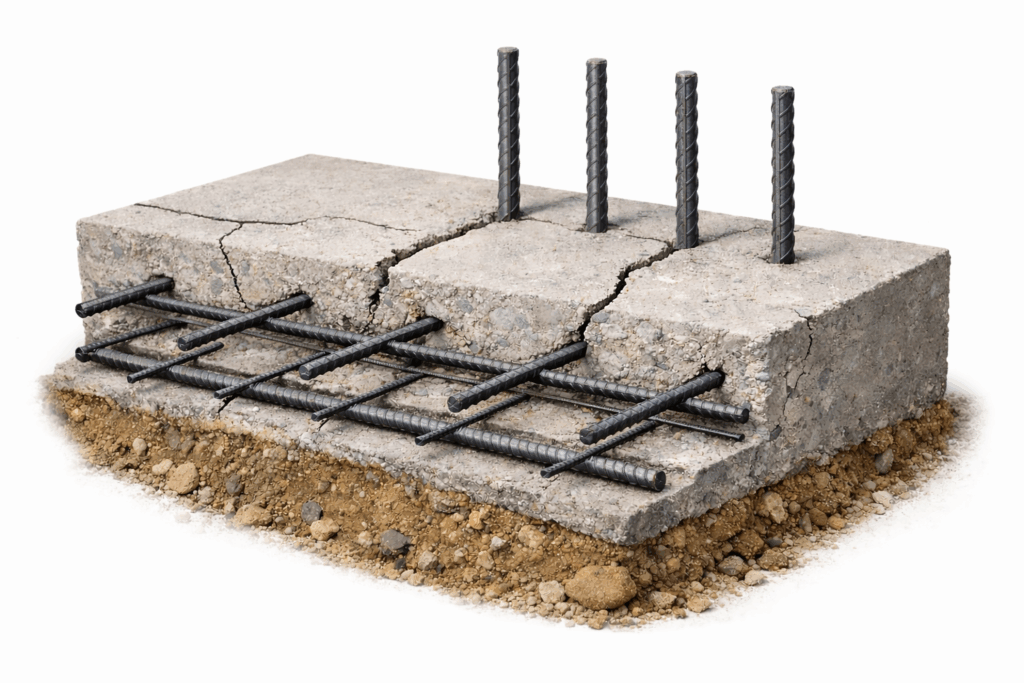
Why Rebar Is Used
Rebar (or reinforcement bar) is a steel bar embedded in concrete to resist tensile forces, where concrete is inherently weak. It is typically made of carbon steel with surface deformations that improve bonding with the concrete. Steel and concrete have similar coefficients of thermal expansion, allowing them to act together as a composite material without internal stress due to temperature changes.
By carrying tension from bending, settlement, uplift, and lateral loads, rebar limits cracking, improves structural integrity, and provides ductile behavior, preventing sudden brittle failure that can occur in unreinforced concrete.
Rebar Sizes
| Rebar Size | Diameter | Typical Use |
|---|---|---|
| #3 | 3/8 in | Slabs, light reinforcement |
| #4-#5 | 1/2 in-5/8 in | Footings, walls, residential foundations |
| #6-#7 | 3/4 in-7/8 in | Structural beams, large foundations |
| #8-#18 | 1 in-2 1/4 in | Heavy commercial / industrial |
Minimum Reinforcement Ratio (ACI-Based)
A minimum reinforcement ratio ensures:
- Cracks are distributed, not concentrated
- Steel yields before concrete crushes (ductile behavior)
- Shrinkage and temperature cracking is controlled
For reinforced concrete flexural members (beams, footings, slabs):

Where:
ρ = steel ratio
fc′ = concrete compressive strength (psi)
fy = steel yield strength (psi)
With typical values (4000 psi concrete and Grade 60 reinforcing steel), the minimum required steel ratio is approximately 0.18% of the concrete cross-section.
Rebar Spacing and Concrete Cover
Meeting the minimum steel ratio alone is not sufficient for proper structural performance. Rebar spacing, placement, and concrete cover directly control cracking, durability, and corrosion resistance. To ensure effective crack distribution, reinforcement spacing is typically limited to 12–18 in , with #4 bars at 12 in on center being common practice for footings and slabs. In footings and slabs subjected to upward soil pressure, the primary reinforcement is placed near the bottom of the concrete section, where tensile stresses occur due to bending. Rebar must also be positioned with adequate concrete cover to protect the steel from moisture, soil exposure, and fire. Standard minimum cover requirements are 3 in for concrete cast directly against soil, 2 in for formed footings, and ¾–1 in for interior slabs. Insufficient spacing, improper bar placement, or inadequate cover commonly leads to excessive cracking, corrosion, and premature structural deterioration.
For guidance with your next project, explore our Plans, Calculators, Knowledge Base,
or contact us directly for site-specific support
Last Update: February 4, 2026
Related Knowledge Base Posts -
- Should a professional utilize the ASD (Allowable Stress Design) method or the LRFD (Load Resistance Factored Design) method when calculating the required wind pressure for use with tested-approved systems?
- Did the wind loading requirements change for rooftop structures for ASCE 7-22 – ASCE 7-16 & The Florida Building Code?
- What wind speed should I use for my project?
- ASCE 7 WIND EXPOSURE CATEGORIES AND HOW EXPOSURE ‘D’ WORKS
- Why are spacing, edge distance, and embedment important for concrete anchors?
- The One-Third (1/3) Stress Increase: Where Is It Now?