
Pedestal-Supported Roof Paver Systems
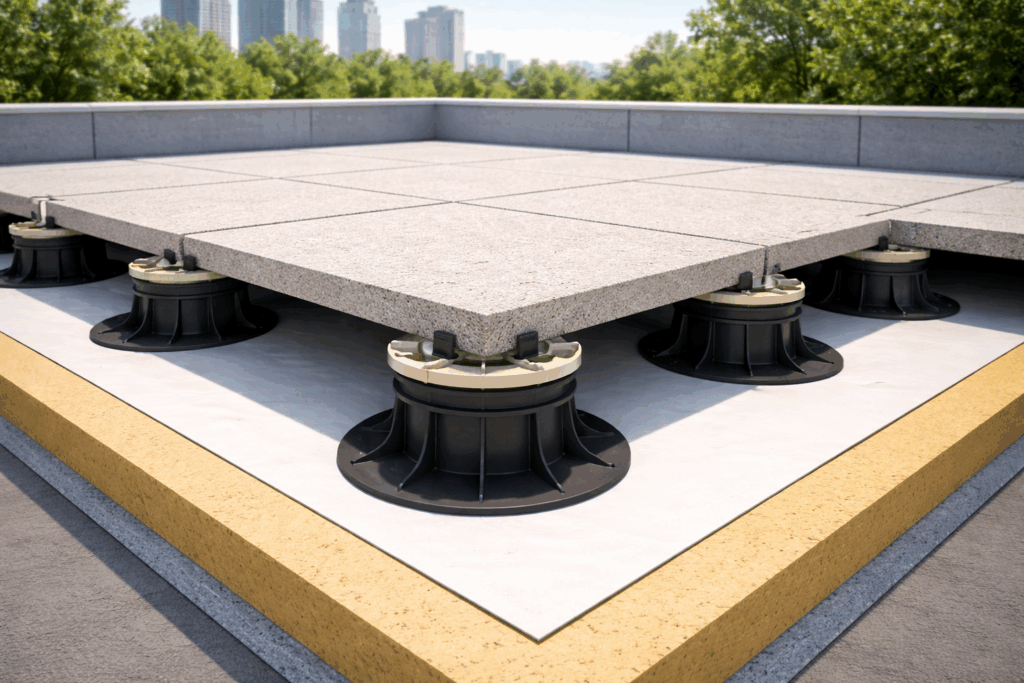
Roof paver systems installed on plastic pedestals are increasingly used to provide accessible walkways, terraces, and service areas on flat roofs. These systems typically consist of concrete, wood, or composite pavers supported by adjustable plastic pedestals, with the pavers either mechanically attached to the pedestals or bonded using adhesives.
Avoidance of Direct Attachment to Roof Membranes
Pedestal systems are usually not mechanically fastened to the roof underlayment or waterproofing membrane. Direct attachment can compromise the integrity of the waterproofing system, increase the risk of leaks, and interfere with the roofing manufacturer’s warranty.
As a result, many roof paver systems rely on self-weight, system continuity, or indirect restraint methods rather than anchorage to the roof deck. This design approach shifts the burden of wind resistance entirely onto the paver–pedestal assembly itself.
Wind Uplift Demands per ASCE 7
Wind uplift pressures acting on roof-mounted systems are governed by ASCE 7, which can result in significant suction forces, especially in perimeter and corner roof zones. These pressures are often controlling in South Florida due to high basic wind speeds.
For allowable stress design (ASD), ASCE 7 load combinations typically require evaluation of 0.6D + 0.6W, meaning that only 60% of the system dead load may be considered to resist 60% of the nominal wind uplift.
Consequently, relying solely on self-weight is often insufficient unless uplift pressures are demonstrably reduced.
Pressure Equalization Phenomenon
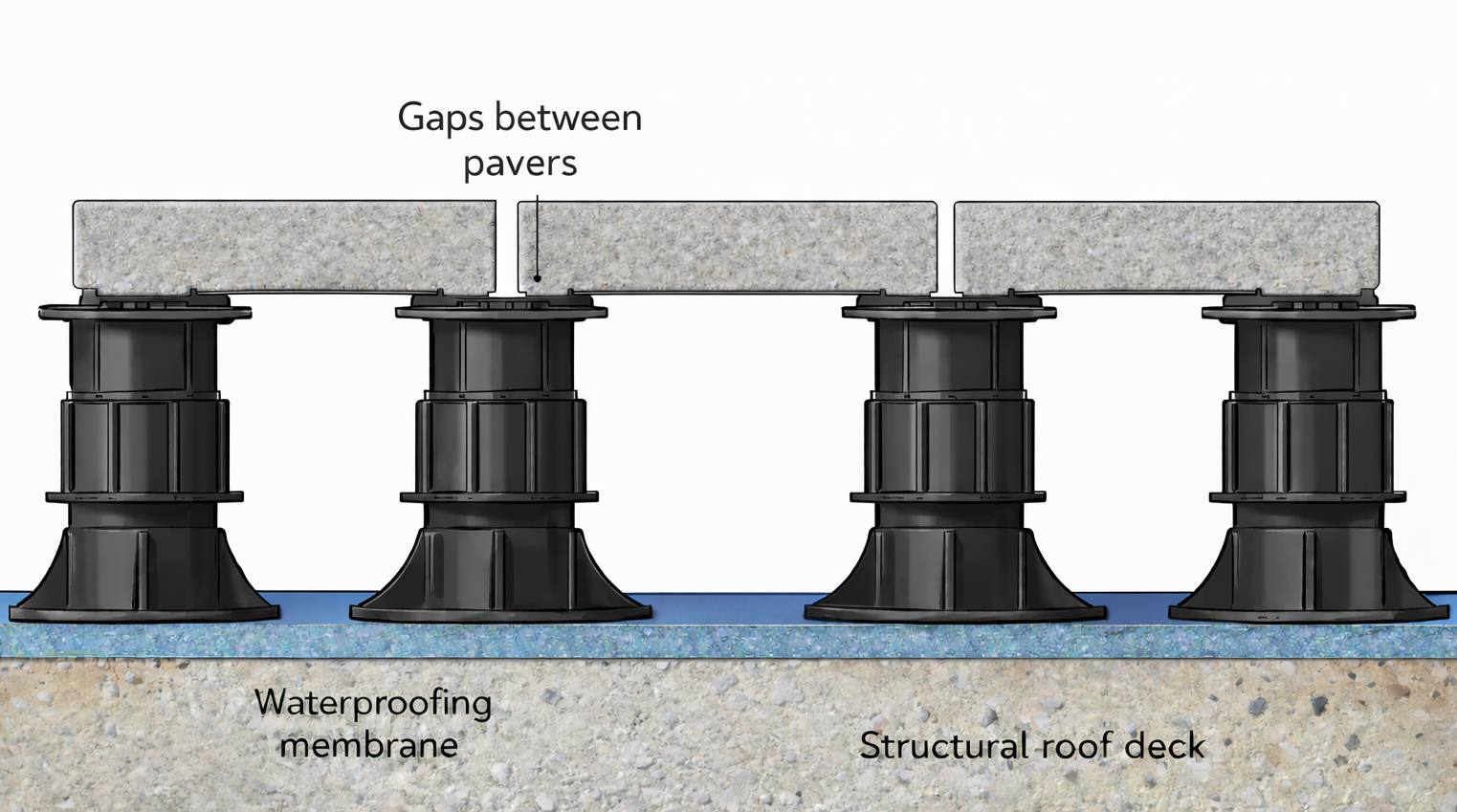
A key factor influencing the performance of loose-laid roof pavers is the pressure equalization effect. Gaps between adjacent pavers, as well as the air space between the bottom of the pavers and the finished roof surface, allow external pressures on the top surface to partially communicate to the underside of the pavers.
This pressure communication reduces the net uplift force acting on the system. Experimental research, including wind tunnel testing on loose-laid concrete roof pavers, has shown that pressure equalization can significantly reduce uplift demands. However, localized effects such as vortices near roof corners and edges can still generate high suctions that are not fully mitigated by equalization.
Limitations of Current Codes and Need for Testing
At present, the Florida Building Code (FBC) and International Building Code (IBC) do not provide explicit design equations or reduction factors to account for pressure equalization in roof paver systems. As a result, demonstrating adequate wind resistance typically requires wind tunnel testing of the specific system configuration.
For guidance with your next project, explore our Plans, Calculators, Knowledge Base,
or contact us directly for site-specific support
Last Update: February 9, 2026
Related Knowledge Base Posts -
- Did the wind loading requirements change for rooftop structures for ASCE 7-22 – ASCE 7-16 & The Florida Building Code?
- What wind speed should I use for my project?
- ASCE 7 WIND EXPOSURE CATEGORIES AND HOW EXPOSURE ‘D’ WORKS
- Why are spacing, edge distance, and embedment important for concrete anchors?
- What wind information is required for construction documents?
- How do I calculate the effective opening area on window or door products? – What opening area should be used for wind pressure determination on a multi-panel product?