
Design of Padel and Outdoor Sports Courts in the United States
Padel courts and outdoor sports facilities, while relatively simple in appearance, are governed in the United States by a comprehensive set of structural, safety, and regulatory requirements. Their design involves not only classical civil and structural engineering considerations, but also strict compliance with building codes such as the International Building Code and loading standards like ASCE 7. In high-risk regions such as Florida, wind loading and glass resistance become critical design drivers. This document outlines the key regulatory constraints and engineering obligations that must be addressed to ensure safe, compliant, and constructible padel and outdoor sports court projects.
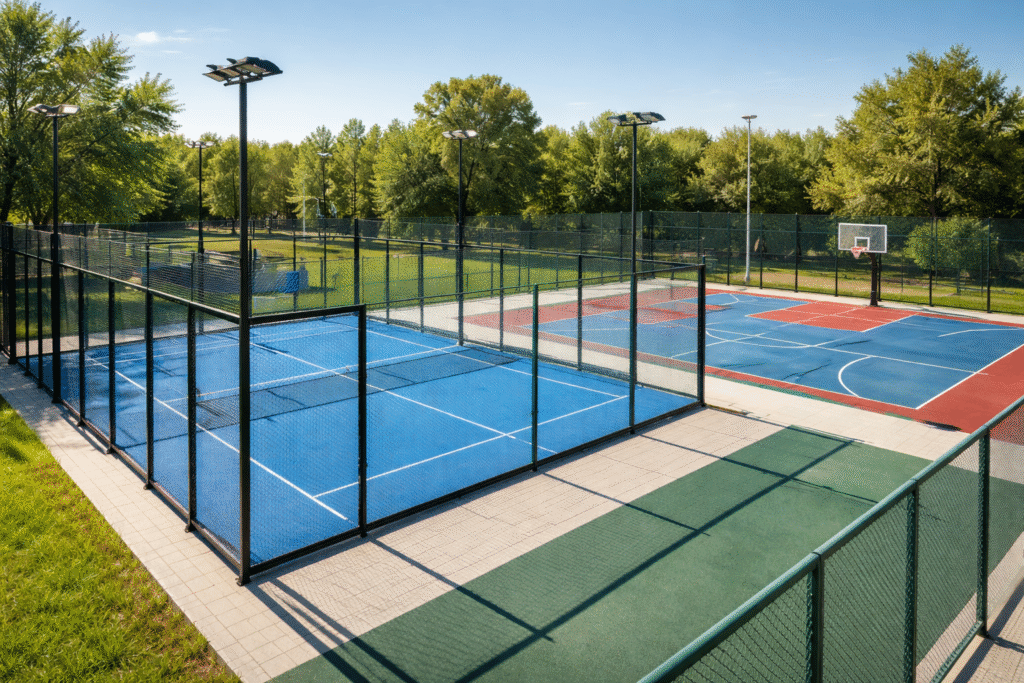
Zoning, Permitting, and Land Use Constraints
The design and construction of outdoor sports courts in the United States are first governed by local zoning ordinances, which define whether recreational facilities are permitted within a given parcel. These regulations are issued at the municipal or county level and directly influence the feasibility of a project. Engineers must ensure compliance with setbacks, land coverage ratios, parking requirements, and restrictions related to lighting and noise. In many cases, the construction of a padel or tennis court requires not only a standard building permit but also a conditional use permit and formal site plan approval. These administrative steps are critical because they can impose geometric and operational constraints that directly affect structural layout, orientation of the court, and placement of lighting systems. General guidance on zoning practices can be found through the American Planning Association.
From a structural engineering perspective, padel courts are classified as light structures composed of steel framing and glass infill panels, and they must comply with the International Building Code and the loading provisions of ASCE 7 .
The governing design case for these structures is almost always wind loading, particularly in regions such as Florida where basic wind speeds can reach 140 to 180 mph depending on the risk category and location. According to ASCE 7 Chapters 26 through 30, wind pressures must be calculated using exposure categories, gust factors, and pressure coefficients that account for partially enclosed structures. Because padel courts behave aerodynamically as semi-enclosed volumes with large vertical surfaces, both external and internal pressures must be considered simultaneously. This results in significant uplift and lateral loads on the steel frame and anchorage system, which must be transferred safely to the foundation. The International Building Code further requires that load combinations and resistance factors be applied to ensure structural safety under ultimate limit states.
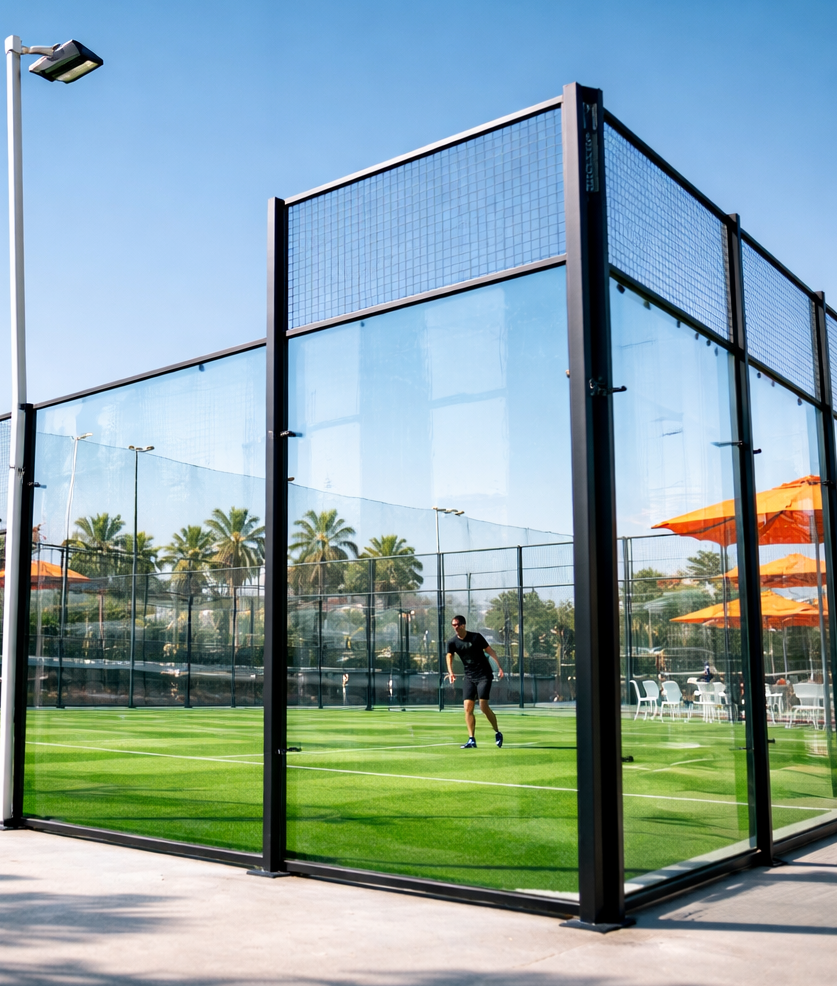
Glass Panels: Resistance, Standards, and Wind Pressure Capacity
A defining feature of padel courts is the use of tempered glass panels, typically 3/8 to 1/2 inch thick, which act both as playing surfaces and as structural elements resisting wind loads. These panels must comply with safety glazing requirements such as the federal regulation CPSC 16 CFR 1201. However, it is important to note that these standards address impact safety rather than structural wind resistance, meaning that engineers must independently verify glass capacity under wind loading.
In practice, the allowable wind pressure on padel glass is not explicitly defined in U.S. codes, but is derived from glass design standards such as ASTM E1300. For a typical 1/2 inch tempered glass panel with dimensions around 6.5 ft by 10 ft and standard support conditions, the allowable design pressure generally falls in the range of approximately 30 to 50 psf, depending on edge support, load duration, and safety factors. Ultimate failure pressures can be significantly higher, often exceeding 70 to 100 psf, but design must remain within allowable stress limits with appropriate factors of safety. In high-wind regions such as Florida, calculated design pressures from ASCE 7 can approach or exceed these values, which makes the glass panels a critical governing element in the structural design. As a result, engineers frequently need to optimize panel size, thickness, and support spacing, or introduce additional framing to reduce effective spans and maintain compliance.
Additional Technical Information
Accessibility Requirements (ADA Compliance)
All publicly accessible sports facilities must comply with the Americans with Disabilities Act , which imposes strict requirements on accessibility. From an engineering standpoint, this includes the provision of continuous accessible paths with controlled slopes, adequate widths, and stable, slip-resistant surfaces. At least one accessible entry point to the court must be provided, and any associated facilities such as seating, parking, or rest areas must also comply with ADA standards. These requirements must be integrated early in the design phase because they influence grading, drainage, and overall site layout. Retrofitting accessibility after construction is often impractical and costly.
Drainage, Pavement Design, and Environmental Regulations
Outdoor courts must be designed to ensure proper water evacuation and long-term durability. A typical court incorporates a slight slope, generally between 0.5% and 1%, to prevent water accumulation while maintaining playability. The structural pavement system usually consists of an asphalt or concrete base topped with a synthetic sports surface, and must be designed according to subgrade conditions and expected environmental exposure. In addition to performance considerations, environmental regulations play a major role. Projects disturbing significant land area must comply with the Clean Water Act and permitting requirements from the Environmental Protection Agency, including the development of a Stormwater Pollution Prevention Plan. These constraints directly affect grading design, drainage systems, and construction practices.
Lighting, Electrical Systems, and Energy Compliance
Lighting design for outdoor sports courts must satisfy both performance and regulatory requirements. Illumination levels must be sufficient to ensure safe play, typically ranging from 200 lux for recreational use to over 500 lux for competitive environments, while maintaining uniformity and minimizing glare. At the same time, lighting installations must comply with the International Energy Conservation Code and electrical provisions from the National Electrical Code . Local regulations often impose additional limits on light trespass and nighttime operation. Structurally, lighting poles must also be designed for wind loads in accordance with ASCE 7, which can be a governing factor in hurricane-prone regions.
While this statute allows virtual inspections by private providers, the local building official remains the Authority Having Jurisdiction (AHJ) and retains oversight of permitting and occupancy approvals.
CONCLUSION
The design of padel courts in the United States requires compliance with multiple regulatory frameworks, with wind loading and glass resistance often governing the structural design, especially in high-wind regions such as Florida. As U.S. codes do not explicitly define allowable pressures for padel glass, engineers must ensure that designs based on ASCE 7 remain within safe limits through detailed analysis.
For your next padel courts or outdoor structural project, ensure your design meets the highest standards of safety, performance, and code compliance. Contact Engineering Express to get plans, certification and expert support in structural analysis, connection design, and permitting-ready engineering for projects across the United States.
For guidance with your next project, explore our Plans, Calculators, Knowledge Base,
or contact us directly for site-specific support
Last Update: March 22, 2026
Related Knowledge Base Posts -
- Should a professional utilize the ASD (Allowable Stress Design) method or the LRFD (Load Resistance Factored Design) method when calculating the required wind pressure for use with tested-approved systems?
- What wind information is required for construction documents?
- Can an engineer design alternate anchorage for a Florida product approval or other product evaluation?
- Handrail and Guardrail Design Guidelines
- ASCE 7 Least Horizontal Dimension – Minimum Building Width
- ASCE 7 Wall Zones 4 & 5 Explained