
Virtual inspections for PEs in U.S. buildings
Virtual inspections moved from a pandemic workaround to a mainstream option in many U.S. jurisdictions, but what’s allowed by a building department is not always the same as what a Professional Engineer (PE) can responsibly certify under licensure rules, standard of care, and contract/insurance constraints.

What is a virtual inspection?
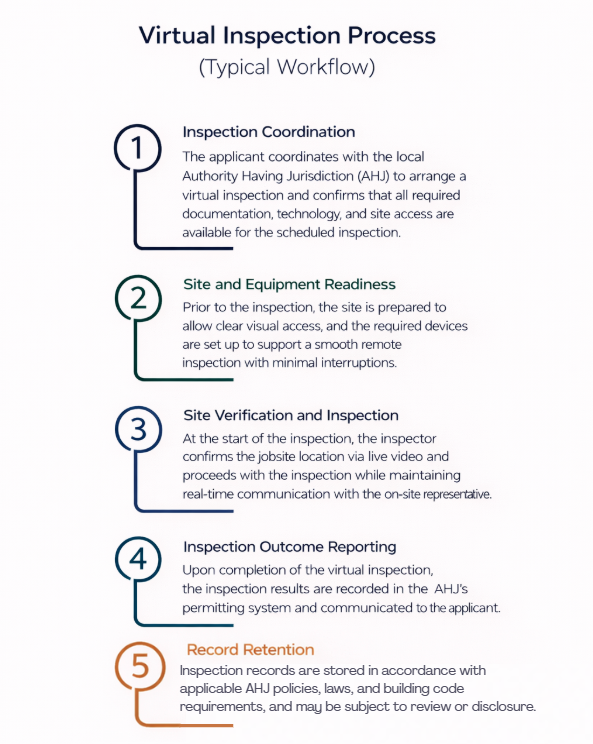
A virtual inspection (also referred to as a remote virtual inspection or RVI) is a building inspection conducted without the inspector being physically present on site, using electronic means such as:
- live video conferencing,
- photographs or recorded video
- other visual or electronic tools that allow verification of work in place.
At the national level, the International Code Council (ICC) recognizes virtual inspections and has issued recommended practices for jurisdictions that choose to allow them.
These ICC documents are guidance only. They do not create legal authority. Whether a virtual inspection is permitted depends entirely on state law and/or local AHJ (Authority Having Jurisdiction) policy.
In Florida
1. Legal authorization
Florida Statute §553.79 authorizes state and local building enforcement agencies to perform virtual inspections at their discretion and formally defines a virtual inspection as a visual inspection conducted using electronic means.
This statutory language provides statewide legal recognition of virtual inspections, subject to local administrative policies.
2. Statutory limitation: threshold buildings
Florida law places a clear restriction on the use of virtual inspections for structural work on threshold buildings.
Under §553.79, structural inspections of threshold buildings may not be performed virtually by state or local enforcement agencies.
A threshold building is defined in §553.71 and generally includes buildings exceeding three stories or 50 feet in height, as well as certain large assembly occupancies.
3. Private provider inspections
Florida Statute §553.791 governs inspections performed by private providers and explicitly states that required inspections may be performed either in person or virtually.
While this statute allows virtual inspections by private providers, the local building official remains the Authority Having Jurisdiction (AHJ) and retains oversight of permitting and occupancy approvals.
4. Local authority and discretion
Even with statewide authorization, Florida law preserves local discretion. Building officials may:
- limit which inspection types are eligible for virtual inspection,
- impose documentation and technology requirements, and
- require in-person inspections when conditions cannot be adequately verified remotely.
As a result, implementation can vary between jurisdictions within Florida.
The Rest of the United States: Local Authority Control
Outside Florida, most U.S. states do not have statewide statutes that explicitly authorize or prohibit virtual inspections. Instead, acceptance is generally governed at the local level, through building department policies, administrative interpretations of adopted building codes (such as the IBC and IRC), or inspection programs adopted by individual cities or counties. National guidance, including from the U.S. Department of Energy, confirms that Authority Having Jurisdiction (AHJ) determines whether and how virtual inspections may be implemented.
Practical Impact
Because there is no uniform national rule, virtual inspections across the U.S. are typically conditional and jurisdiction-specific. Even where allowed, AHJs often restrict virtual inspections to minor work or re-inspections, exclude structural or life-safety elements, and reserve the right to require an in-person inspection at any time. As a result, in states other than Florida, virtual inspections are not automatically permitted and must be evaluated case by case with prior approval from the local Building Department
Pros
Virtual inspections reduce scheduling delays by eliminating travel and allowing faster coordination.
They lower inspection costs by minimizing time and transportation requirements.
Virtual inspections are effective for minor work, re-inspections, and clearly visible conditions.
They provide flexibility when site access, weather, or logistics make in-person inspections difficult.
In jurisdictions like Florida, virtual inspections are explicitly authorized by statute, providing regulatory clarity.
Cons / Inconvenients
Virtual inspections are not universally accepted and often require prior approval from the local AHJ.
Visibility limitations may prevent reliable verification of certain construction conditions.
Structural and life-safety inspections are commonly restricted or prohibited from being performed virtually.
Acceptance and requirements vary significantly between jurisdictions, even within the same state.
Engineers and inspectors remain fully responsible for meeting the professional standard of care, regardless of inspection method.
For guidance with your next project, explore our Plans, Calculators, Knowledge Base,
or contact us directly for site-specific support
Last Update: February 12, 2026
Related Knowledge Base Posts -
- Should a professional utilize the ASD (Allowable Stress Design) method or the LRFD (Load Resistance Factored Design) method when calculating the required wind pressure for use with tested-approved systems?
- Did the wind loading requirements change for rooftop structures for ASCE 7-22 – ASCE 7-16 & The Florida Building Code?
- What wind speed should I use for my project?
- ASCE 7 WIND EXPOSURE CATEGORIES AND HOW EXPOSURE ‘D’ WORKS
- About ASTM E1996 Missile Levels & Wind Zone 4
- What wind information is required for construction documents?