
Welded Aluminum Railings: Structural Risks, Code Requirements, and Design Considerations
Welded aluminum railings are commonly used in residential, commercial, and outdoor applications due to their durability, corrosion resistance, and clean architectural appearance. However, from an engineering standpoint, welding aluminum—especially heat-treated alloys such as 6061-T6 or 6063-T6—introduces critical structural considerations that must be properly addressed to ensure compliance with U.S. building codes and life-safety requirements.
Railings are classified as life-safety elements, particularly when installed at elevations greater than 30 inches above grade. As such, their design is governed not only by material properties but also by strict load requirements and connection performance criteria.
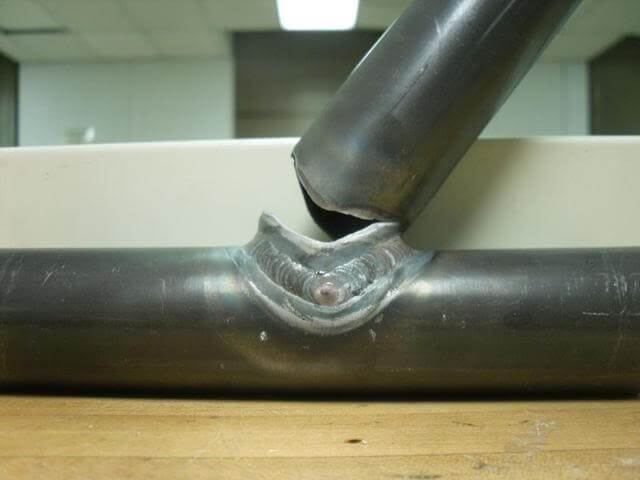
Structural Behavior and Code Requirements
Railing posts behave primarily as cantilevered members, with loads applied at the top rail generating bending moments that are resisted at the base connection. As a result, the maximum bending stress occurs at the base of the post, making this region critical for design. Building codes such as the International Building Code (IBC) require guardrails to resist a 200 lb (0.89 kN) concentrated load applied at the top rail (IBC 2021, Section 1607.8.1). Because this load produces peak stresses at the base, any weld located in this region directly reduces the effective load-carrying capacity of the system and must be carefully evaluated in design.
For example, a railing is classified as a life-saving fall guard for any elevation above 31 inches above grade. The aluminum alloys normally used (such as 6061-T6) get their strength from a heat-treatment process. Welding weakens the heat-treated aluminum in the vicinity of the weld, called the heat-affected zone (HAZ), reducing the strength by approximately 40 percent.

Effect of Welding (Heat-Affected Zone – HAZ)
Welding creates a heat-affected zone (HAZ) where the aluminum loses part of its mechanical strength due to thermal exposure.
- 6061-T6 typically degrades to approximately T4-level properties in the HAZ
- Strength reductions of 30% to 50% are common
Design guidance for welded aluminum is provided in the Aluminum Design Manual (ADM), which specifies reduced allowable stresses in welded regions.
Ignoring this reduction is a major source of unsafe or non-compliant designs.
Key Design Risks and Best Practices
Critical Risks
- Welds at post base → reduced strength where stress is highest
- Connection governs failure → often more critical than the member itself
- Incorrect material assumptions → using T6 properties in the HAZ
Recommended Strategies
- Avoid welds in high-moment regions (especially near post bases)
- Use larger or thicker sections to compensate for strength loss
- Prefer mechanical (bolted) connections in critical zones
- Reinforce connections with sleeves, gussets, or base plates
- Use modular fabrication (weld secondary elements, not primary load paths)
Aluminum railings are typically fabricated using MIG (GMAW) or TIG (GTAW) welding processes with filler metals such as ER4043 or ER5356, in accordance with AWS D1.2 – Structural Welding Code – Aluminum .
CONCLUSION
Welded aluminum railings provide clear benefits in terms of durability, weight, and fabrication efficiency; however, welding introduces a localized reduction in material strength that must be accounted for in design, particularly at the base of posts where bending stresses are highest. To ensure safe and code-compliant performance, engineers must consider the effects of the heat-affected zone (HAZ), avoid placing welds in critical regions, and use appropriate detailing strategies such as mechanical connections or reinforced sections, thereby ensuring the structural integrity and reliability of the railing system under required loading conditions.
For your next project, ensure your design meets the highest standards of safety, performance, and code compliance. Contact Engineering Express to get plans, certification and expert support in structural analysis, connection design, and permitting-ready engineering for projects across the United States.
For guidance with your next project, explore our Plans, Calculators, Knowledge Base,
or contact us directly for site-specific support
Last Update: March 23, 2026
Related Knowledge Base Posts -
- ASCE 7 WIND EXPOSURE CATEGORIES AND HOW EXPOSURE ‘D’ WORKS
- Why are spacing, edge distance, and embedment important for concrete anchors?
- What is a window or door buck
- What’s the dimensional difference between a pipe and a tube?
- Metal Fasteners UNC vs Spaced Thread
- Minimum Edge Distance Requirements for Bolts & Screws in Metal (Steel & Aluminum)