
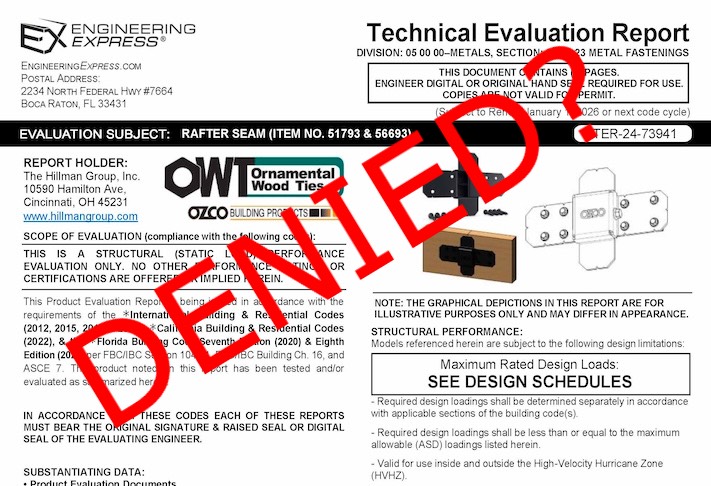
Why Your TER Might Get Rejected — and How to Fix It
A Technical Evaluation Report (TER) is an engineer-certified evaluation of a product’s structural performance limits (wind, gravity, etc.). However, submitting a TER alone does not guarantee approval by a permitting authority. Various factors during the permit review process can lead to additional requirements or rejection if submitted documentation doesn’t meet the project-specific expectations.

What Is a Technical Evaluation Report
A TER is a document that describes the capacity of a building product or component based on testing or rational engineering analysis. It outlines performance limits such as allowable wind pressures or load capacities, but does not inherently address project-specific conditions like site exposure, risk category, or unique installation parameters.
Common Reasons a TER Is Not Approved for Permit
1. Lack of Project Certification
Some Authorities Having Jurisdiction (AHJs) require a Design Professional (PE/SE) to certify that the TER applies to your specific job conditions. A generic TER may demonstrate product limits but not verify suitability for the actual structural context
SOLUTION: A Design Professional needs to certify that the TER/plan meets the job conditions either by a letter, site-specific plan, or other building-department approved method.
2. Unsealed or Uncertified Submission
If the TER submitted is unsigned, uncertified, or lacks the required seals, many plan reviewers will reject the document because it doesn’t meet code documentation standards.
SOLUTION: Order sealed copies of the TER from the Online Plan Store or have your engineer provide sealed documentation
Insufficient Copies for Review
Building departments often require multiple sealed copies for record retention and cross-discipline review.
SOLUTION: Provide additional sealed copies as requested by the reviewer.
4.Need for Supplementary Engineering Documentation
Reviewers may ask for additional calculations, drawings, or clarifications related to loads, connections, or code compliance.
SOLUTION: Work with your building engineer or request additional supporting calculations from Engineering Express through a Project Request.
5.Product Use Outside TER Assumptions
TERs are based on defined test conditions and installation assumptions. If a product is used outside these limits, permitted authorities may not accept the TER.
SOLUTION: Perform a site-specific structural analysis or adapt the TER through engineering calculations tailored to the actual installation scenario.
6. Permitting Authority Is Unfamiliar With TERs
In some jurisdictions, plan reviewers may not be familiar with TERs or how to interpret them, leading to unnecessary pushback
SOLUTION: Provide explanatory resources, clarify how TERs function, and reference code language defining their use. Direct reviewers to this article.
A Technical Evaluation Report (TER) is an effective tool for demonstrating the structural capacity of pre-engineered products, but it is rarely sufficient on its own for permit approval. While a TER defines performance limits, most jurisdictions require project-specific documentation that confirms the product is suitable for the actual site conditions and code requirements.
Permit success is significantly improved when TERs are used alongside site-specific engineering, including sealed plan sheets that reference the TER and address wind, seismic, and load criteria for the project location. Early coordination with the Authority Having Jurisdiction helps clarify expectations and reduces review delays.
In some regions, particularly in high-wind or hurricane-prone areas, supplementing a TER with higher-level approvals such as Florida Product Approval or a Miami-Dade NOA can further increase acceptance and streamline the permitting process.
For guidance with your next project, explore our Plans, Calculators, Knowledge Base,
or contact us directly for site-specific support
Last Update: February 4, 2026
Related Knowledge Base Posts -
- Should a professional utilize the ASD (Allowable Stress Design) method or the LRFD (Load Resistance Factored Design) method when calculating the required wind pressure for use with tested-approved systems?
- What are the requirements for using ASTM Missile Level E in Florida and the US?
- How do I calculate the effective opening area on window or door products? – What opening area should be used for wind pressure determination on a multi-panel product?
- Can an engineer design alternate anchorage for a Florida product approval or other product evaluation?
- What is a TER and how is it used for permitting?
- What Doesn’t A Technical Evaluation Report (TER) or Product Evaluation Do?