Codes & Standards

Our interpretations of the many codes and standards in our engineering industry

Requirements of Plan Reviewers When Denying Permits & Alternate Methods FBC-IBC Section 104.11

Florida Statute 555.79(1)(a) lists the requirements and penalties of building plan reviewers when they issue comments and deny permit applications. Here’s an excerpt from that section with a link to the source file here: FS 553.79 Permits; applications; issuance; inspections.— (1)(a) … Whenever a permit required under this section is denied or revoked because the plan, or …

Requirements of Plan Reviewers When Denying Permits & Alternate Methods FBC-IBC Section 104.11 Read More »

Is Steel or Reinforcing or Fibermesh Required in Posts & Footings of Building Components?

INTRODUCTION The main purpose foundations serve is to distribute and resist the forces or loads experienced by the host structure due to wind, rain, snow, seismic, & other load conditions. When it comes to building components such as generators, signs, and fences the code leaves a gray area for foundation design. This happens because most …

Is Steel or Reinforcing or Fibermesh Required in Posts & Footings of Building Components? Read More »

ASCE 7 Main Wind Force vs. Components & Cladding Explained (MWFRS vs. C&C)

ASCE 7 separates wind loading into three types: Main Wind Force Resisting System (MWFRS), Components and Cladding (C&C), and Other Structures and Building Appurtenances. MWFRS is defined as “(a)n assemblage of structural elements to provide support and stability for the overall structure.” Typically, members that receive loading from two surfaces are designed to resist MWFRS …

ASCE 7 Main Wind Force vs. Components & Cladding Explained (MWFRS vs. C&C) Read More »

ASTM, SEI, ISO Fastener Material Properties and Specifications

Here is a list of fastener markings for various grades of anchors.   Information is reprinted courtesy of American Fastener   FASTENER GRADE MARK (SCROLL DOWN TO SEE A CHART OF MARKINGS ON THE FASTENER TO IDENTIFY THEM) Identification Grade Mark Specification Fastener Description Material Nominal Size Range (in.) Mechanical Properties Proof Load(psi) Yield StrengthMin (psi) …

ASTM, SEI, ISO Fastener Material Properties and Specifications Read More »

Is a large missile impact window or door automatically approved for small missile impact?

Overview Changes to the 2020 Florida Building Code for Porous Impact Protection Devices Porous Impact Protective Systems: ASTM E1996-12A brought a significant change to Porous Impact Protective Systems (PIPS). A Porous Impact Protective System is defined as “An assembly whose aggregate open area exceeds 10% of its projected surface area”. Prior to ASTM E1996-12A, any …

Is a large missile impact window or door automatically approved for small missile impact? Read More »

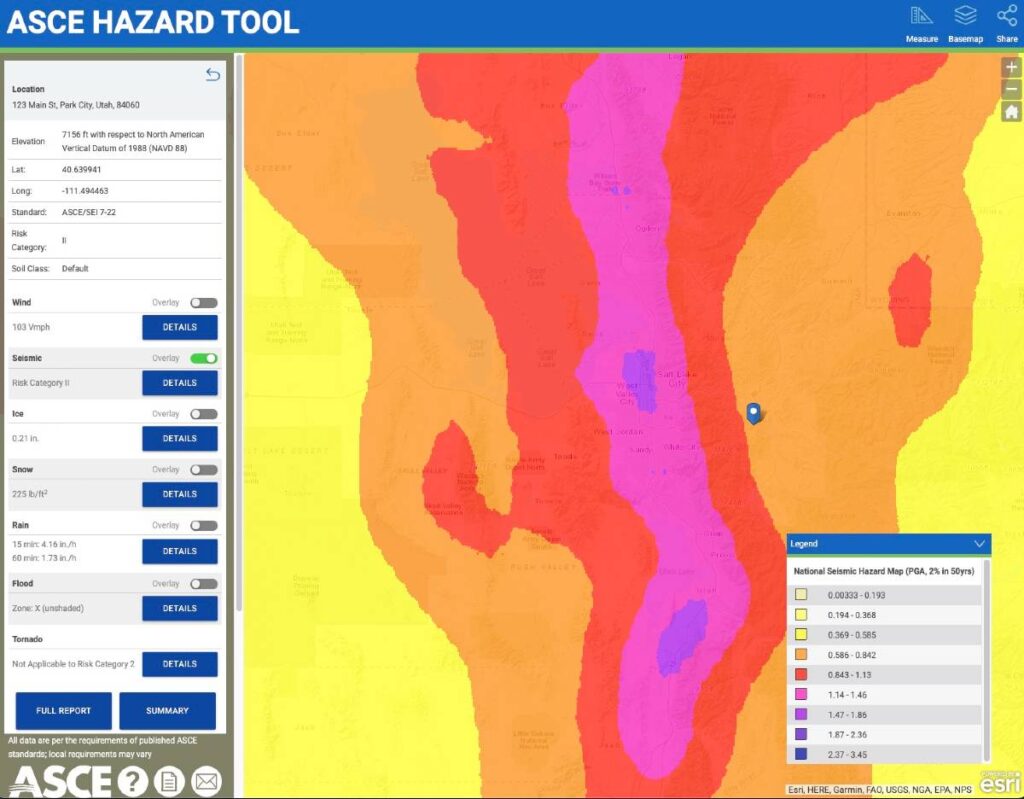
What Seismic area is my location?

Here are some useful sites to check the seismic criteria for a location:   https://www.fema.gov/earthquake-hazard-maps https://earthquake.usgs.gov/hazards/designmaps/ – USGS https://seismicmaps.org/ https://www.seaoc.org/page/seismicdesignmaptool– Structural Engineer Association of California  

Metal Fasteners UNC vs Spaced Thread

Overview Metal fastening is designed per the requirements of the American Institute of Steel Construction (AISC): Specification for Structural Steel Buildings in conjunction with the American Architectural Manufacturers Association (AAMA): TIR-A9-14 Design Guide for Metal Cladding Fasteners. Types The two most common types of fastener threads used in construction are Unified Coarse Thread (UNC) more …

Metal Fasteners UNC vs Spaced Thread Read More »

Scroll to Top